
How to Vet Auto Transport Carriers
(And Avoid Double Brokering & Fraud)
Every load you dispatch rides on someone else's truck, insurance, and honesty — but the liability and the reputation on the line are yours. Here is the vetting checklist that catches bad carriers before dispatch, the red flags behind most fraud, and what to do when a load goes sideways anyway.
The carrier's failure becomes your problem
As a broker, you sold the customer a safe delivery — then handed the vehicle to a company you may have found twenty minutes ago on a loadboard. If that carrier's insurance lapsed, if the "carrier" was a hijacked identity, or if your load got quietly re-sold to a truck you never vetted, the customer doesn't call the carrier. They call you.
The failure modes are well known: double brokering (your carrier re-sells the load without consent), carrier identity theft (fraudsters book loads on a legitimate MC number with swapped contact details), lapsed or fake insurance (discovered only when there's a claim), and plain non-performance. Every one of them is cheaper to catch before dispatch than after. That's the whole case for a checklist you run every time — not just on carriers that feel off.
New to how the broker–carrier relationship works? Start with what an auto transport broker actually does.
Six checks before every dispatch
Run all six, in order, on every carrier you haven't worked with — and the identity checks (authority, insurance, contact match) even on carriers you have. The list is short on purpose: it has to be fast enough that you actually do it on a busy day.
Verify authority on FMCSA SAFER — every time
Before anything else, look the carrier up by USDOT or MC number on the FMCSA SAFER system. You're confirming three things: the operating authority is Active (not pending, revoked, or reinstated last week), the entity type is a motor carrier — not a broker posing as one — and the company name and address match who you're actually talking to. It takes two minutes and it's the single highest-value check in this list.
- Authority status must be Active — walk away from revoked or inactive
- Confirm entity type: authorized for hire motor carrier, not broker-only
- Name, DBA, and address on file should match the carrier you're dealing with
Confirm insurance — certificate direct from the agent
SAFER shows whether liability insurance is on file, but cargo coverage is what protects the vehicle you're shipping — and cargo insurance isn't federally mandated, so you have to check it yourself. Ask for a certificate of insurance sent directly from the carrier's insurance agent, not a PDF forwarded by the carrier (forged COIs are a standard fraud tool). Confirm the coverage amount fits the load and the policy hasn't lapsed.
- Cargo coverage commonly runs $100k–$250k depending on trailer size — match it to the vehicles on the load
- COI must come from the insurance agent directly; call the agent to verify if anything feels off
- Check effective and expiration dates — lapsed policies are a common failure point
Check the safety record and the age of the authority
FMCSA's safety data shows inspection history, out-of-service rates, and crash records. You're not looking for perfection — you're looking for patterns. Separately, note how old the authority is. Brand-new MC numbers aren't automatically bad (every carrier starts somewhere), but a weeks-old authority claiming a large fleet and instantly accepting your load at a below-market rate is a classic fraud profile.
- Review out-of-service rates and inspection history for patterns, not one-offs
- New authority + big fleet claims + instant cheap rate = treat as a red flag
- For new carriers, start with one load and verify everything else twice
Match contact details against the FMCSA record
Carrier identity theft works by hijacking a legitimate MC number: fraudsters change the phone and email on the FMCSA record (or just spoof them in messages) and book loads as a carrier that has no idea it's happening. Compare the phone and email you're using with what's on file, and be suspicious of records where contact details changed in the last few weeks. A company that's hauled cars for years but emails you from a fresh Gmail account deserves a phone call to the number on file.
- Phone and email should match the FMCSA record — call the number on file to confirm
- Recently changed contact info on a long-standing MC is a top identity-theft tell
- Watch for lookalike email domains and free-mail accounts on established companies
Check ratings and your own history with the carrier
Loadboard ratings are imperfect but useful — a carrier with years of reviews and steady activity on Central Dispatch or Super Dispatch is a very different risk than one with none. Your own dispatch history is even better: a carrier who has delivered clean for you before is the cheapest vetting you'll ever do. Keep that history somewhere you can see it at dispatch time, not buried in old emails.
- Weight recent ratings over old ones; read the negative reviews for the failure mode
- Your past loads with a carrier are the strongest signal you have
- Keep carrier history on the order record so it's visible when you dispatch
Put it in writing — and pay the carrier who hauled
Every dispatch should ride on a written rate confirmation that names the carrier, the equipment, the rate, and — critically — a clause forbidding re-brokering without your written consent. That's your contractual defense against double brokering. Then close the loop on payment: pay the carrier whose truck actually moved the vehicle, verified against the signed BOL, not whoever invoices you first.
- Rate confirmation with a no-re-brokering clause on every load
- Match the invoice and BOL to the carrier you dispatched before releasing payment
- Never pay a 'dispatcher' or third party you didn't contract with
Setting up your brokerage and building your carrier process from scratch? The vetting checklist slots into the bigger picture in how to start an auto transport brokerage.
Six tells that should stop a dispatch
No single flag is proof of fraud — but each one earns a harder look, and two or three together mean find another truck. Most double brokering and identity theft telegraphs itself in these patterns.
The rate is accepted instantly — or it's suspiciously cheap
Fraudulent carriers don't negotiate; they take the load fast at any price because they never intend to haul it. Legitimate carriers push back on cheap freight.
Contact info on the FMCSA record changed recently
The most common carrier identity-theft move: hijack a legitimate MC by swapping in new phone and email, then book loads on its reputation.
COI arrives from the carrier, not the insurance agent
Forged certificates are standard fraud tooling. A real carrier has no problem asking their agent to send the certificate directly to you.
Brand-new authority claiming a large fleet
A weeks-old MC number with '15 trucks' and instant availability across the country doesn't add up — fleets take years to build.
Pressure to prepay, wire funds, or pay a third party
Legitimate auto transport carriers get paid on delivery or on terms, against a signed BOL. Upfront wires to someone you didn't contract with are unrecoverable.
A 'dispatcher' speaking for multiple unrelated MC numbers
Often the front end of a double-brokering operation: your load gets re-sold to a carrier you never vetted, at a rate that guarantees a problem.
A common thread: fraud loves speed and low prices. If a rate that should have been negotiated gets snapped up instantly, that's not luck — it's a business model. Pricing loads at honest market rates is itself a fraud filter; see how to price auto transport loads.
Make the checks part of dispatch, not a separate chore
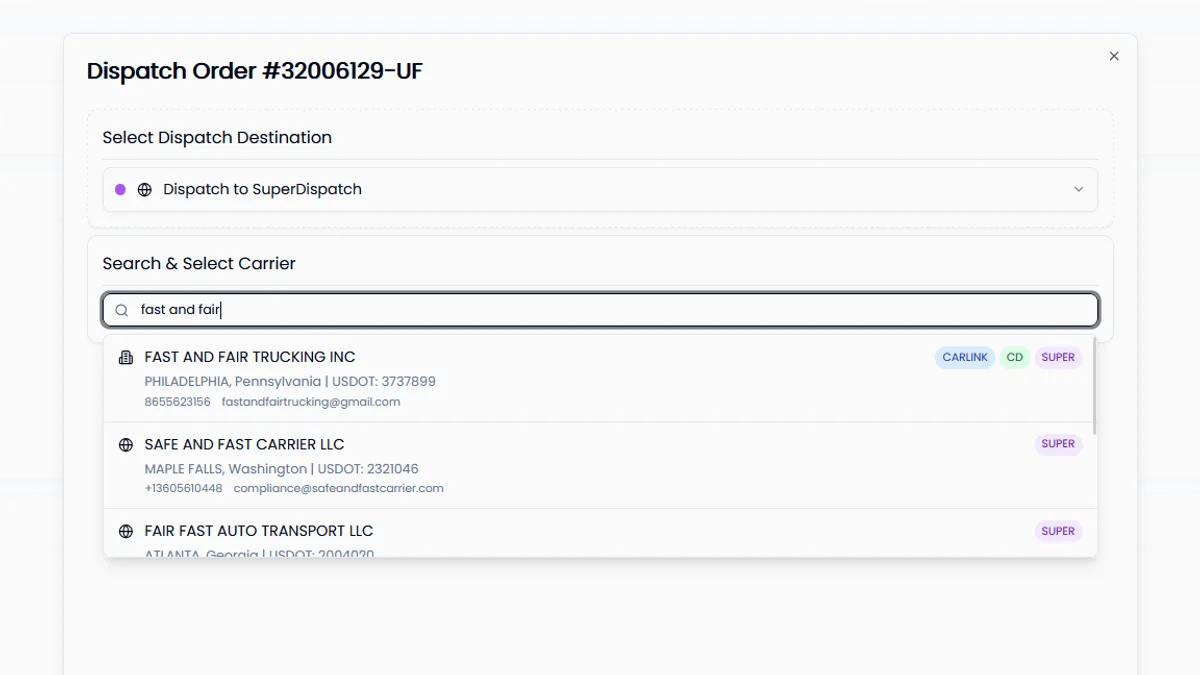
A checklist you have to remember is a checklist that gets skipped on the busiest day — which is exactly when fraud shows up. The fix is putting the vetting signals where the dispatch decision happens. In Carlink, searching for a carrier shows the USDOT number, location, and contact record for every result, whether they come from your own carrier list, Central Dispatch, or Super Dispatch.
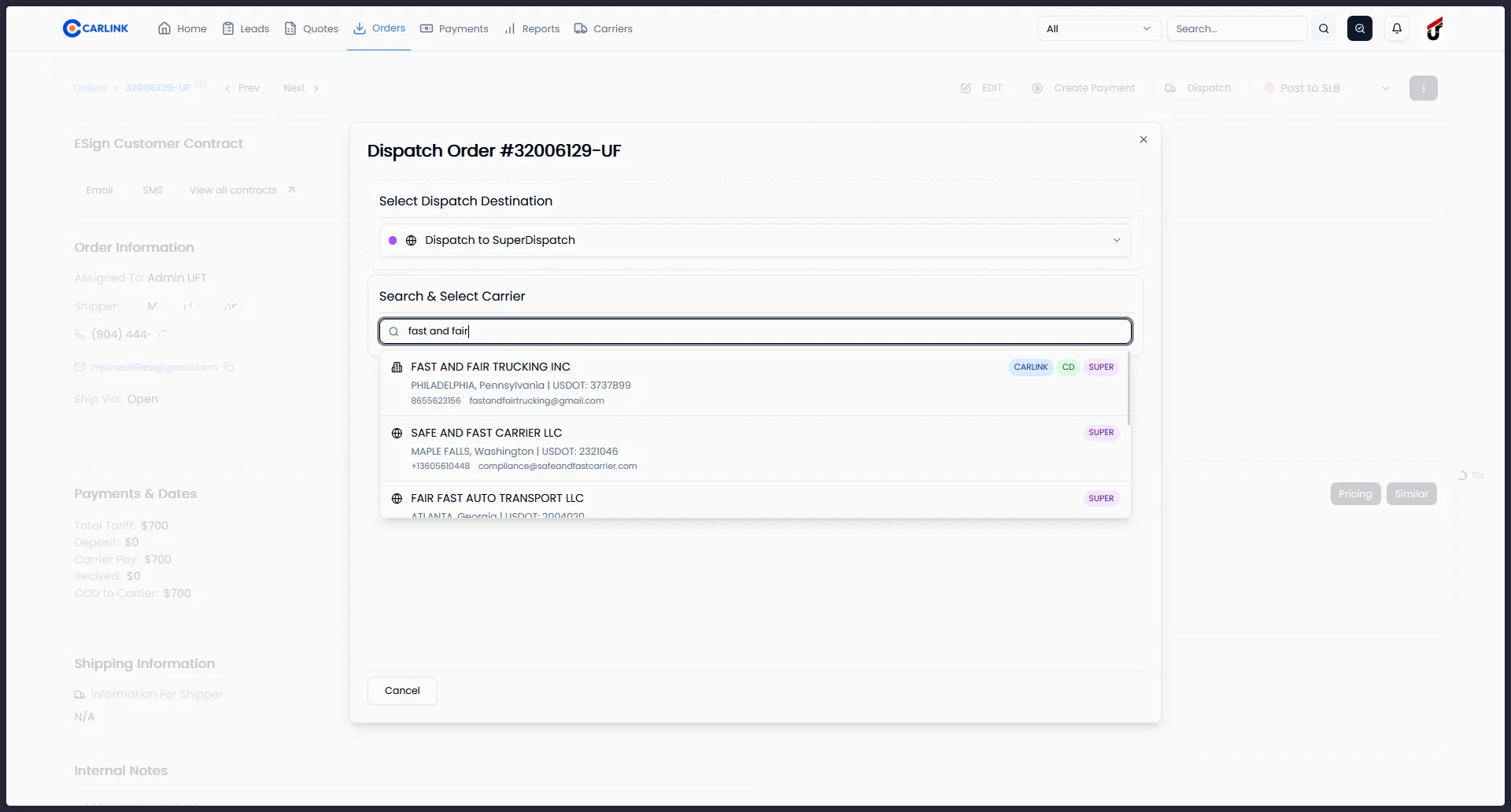
Once a carrier is selected, their full record — address, phone, email, USDOT — sits next to the dispatch settings, and an FMCSA check is one click away right in the dispatch dialog. Every dispatch, payment, and issue is saved to the carrier and the order, so the next time that carrier bids on your load, your own history — the strongest vetting signal there is — is already on the screen.
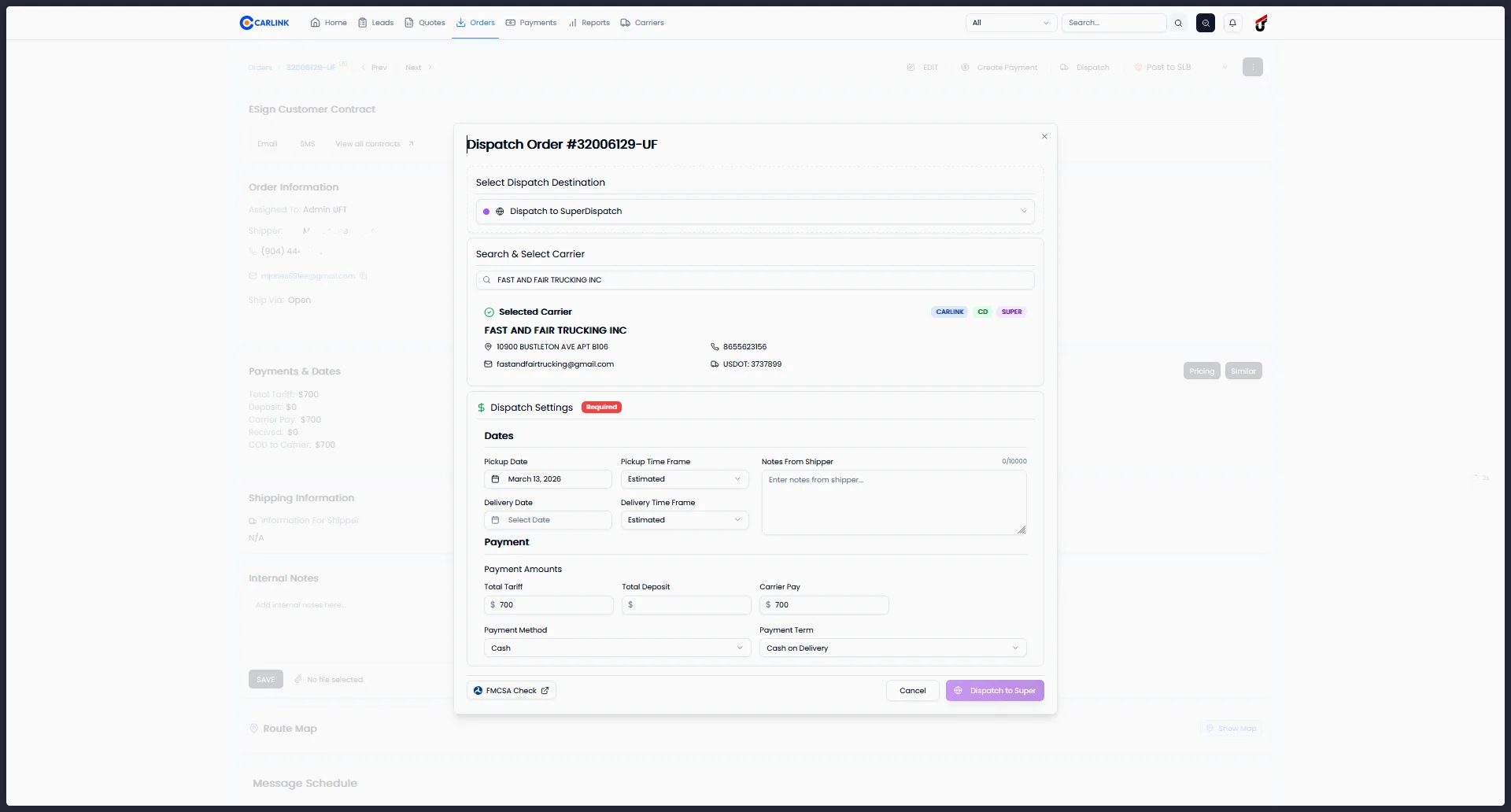
- Vet at the moment of dispatch — carrier search shows USDOT and contact records, with an FMCSA check one click away.Dispatch →
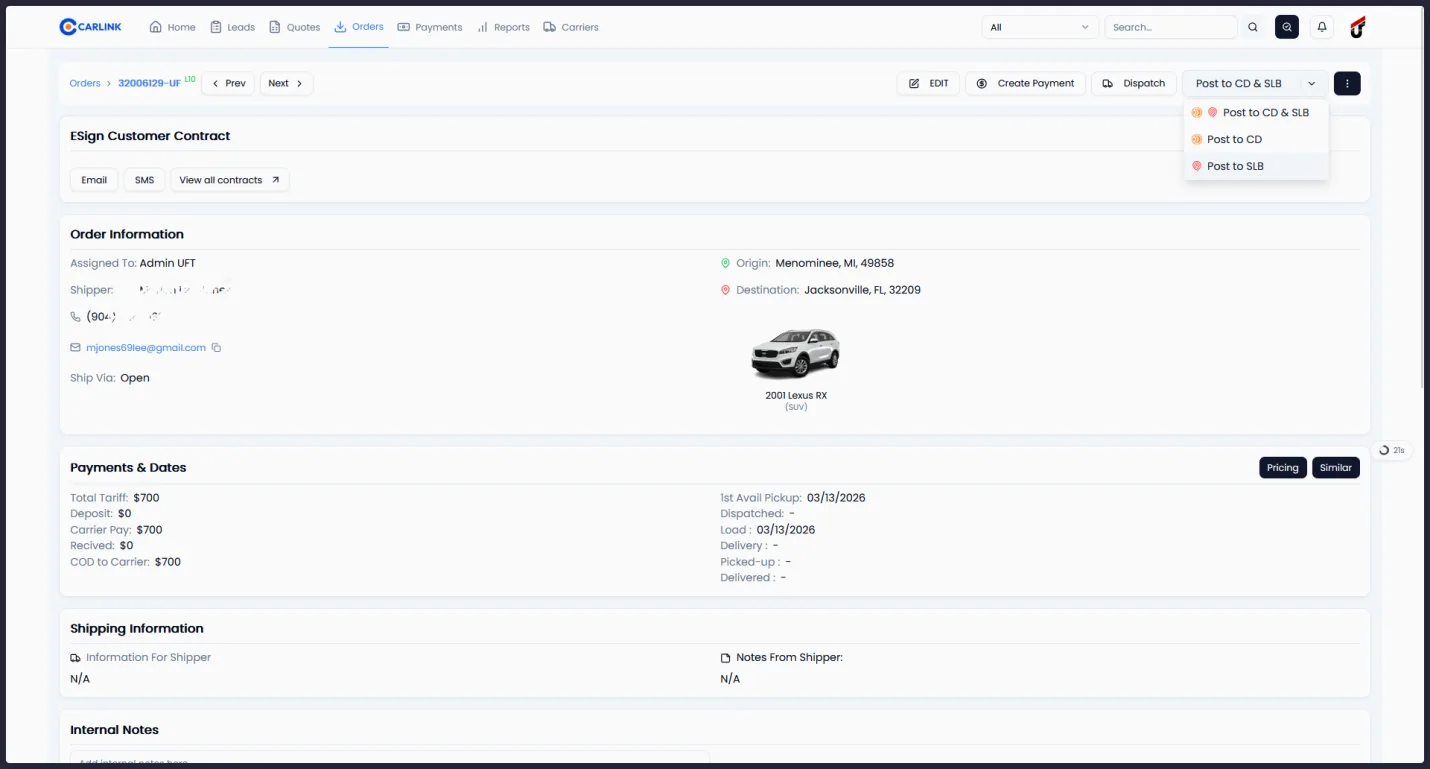
- Work both loadboards from one place — post to Central Dispatch and Super Dispatch and dispatch to carriers without switching tabs.Loadboard →
- Pay the right carrier, every time — carrier pay lives on the order next to the BOL and payment records, so invoices get matched before money moves.Invoicing →
Frequently asked questions
This guide is general industry information, not legal advice. Verify current requirements and carrier records directly with the FMCSA and your own legal and insurance advisors.
Vet every carrier, without slowing down dispatch
Carlink puts USDOT numbers, contact records, an FMCSA check, and your own carrier history inside the dispatch flow — so the checks happen on every load, even on your busiest day. Book a demo and see it on a real order.
More from the Carlink blog
Central Dispatch vs Super Dispatch: Which Loadboard Should You Use?
Central Dispatch has the reach, Super Dispatch has the workflow. A side-by-side comparison for auto transport brokers — carrier network, pricing, dispatch flow, and why most brokerages end up running both from one place.

How to Start an Auto Transport Brokerage (2026 Step-by-Step Guide)
How to start an auto transport brokerage: get your FMCSA broker authority (MC number), the $75,000 surety bond, BOC-3 and UCR filings, what it really costs to start, and how to book your first loads and keep margin.
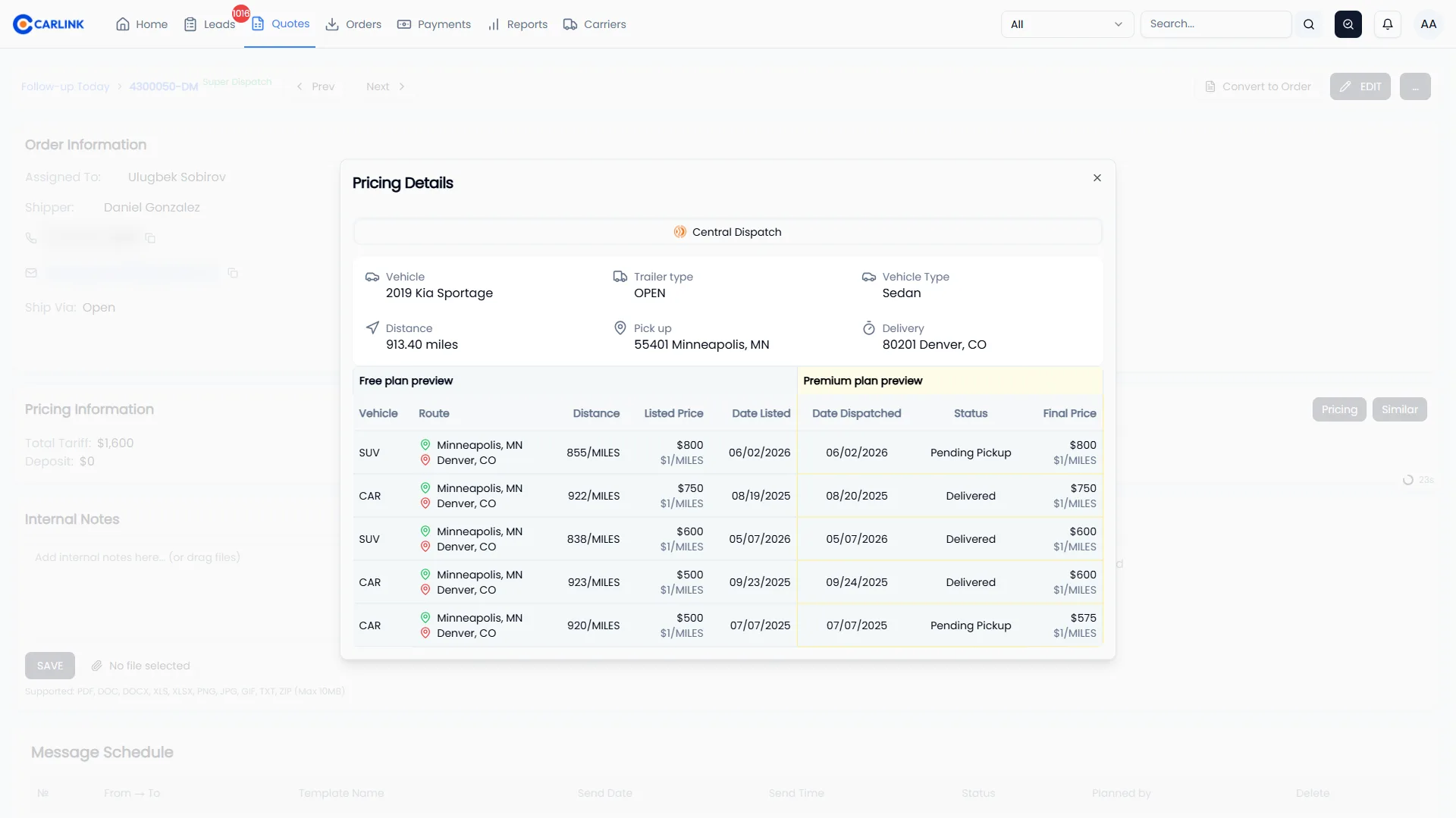
How to Price Auto Transport Loads (Without Losing Margin)
Your quote has to win the customer and still pay the carrier. What moves carrier rates, how to quote from lane history, how to set a margin floor, and how to stop giving away margin on every booking.